Thermostat Diplomacy: Getting a British Hotel Room to the Right Temperature
There's a particular kind of British hotel room that seems to have been designed by committee and then abandoned. The Georgian townhouse with single-glazed sashes that runs cold at seven in the morning and faintly tropical by eleven at night. The 1970s extension where the radiator has two settings, both of them wrong. The modern chain room where the thermostat on the wall is doing an impression of a thermostat rather than actually being one.
None of this is a scandal. Old buildings are old, heating systems are inherited rather than chosen, and a room that suits one guest will always be too warm or too cold for the next. But a bit of local knowledge goes a long way, and most of it doesn't involve anyone fetching a toolbox.
Start with the building, not the controls
Before you start prodding a wall panel, look at the room. A thick-walled stone building will hold the heat from the afternoon and release it slowly into the evening. A top-floor room under a pitched roof will be warmer than the floor below, pretty much always. A room over the kitchen or above a busy bar has a heat source it never asked for. West-facing rooms collect the last of the sun and hold onto it.
If you're booking and you know you sleep hot, it's entirely reasonable to ask for a lower floor or a room at the back — the same request you'd make for quiet. Most independent places will note it. Fewer will promise it, because room allocation on the day is a moving target, but a note costs nothing and often lands.
The radiator valve is your friend
Older UK hotels tend to heat by radiator, and the thermostatic valve on the end usually works even when the rest of the system is temperamental. The numbers run roughly one to five — one is barely on, five is a sauna — and there's often a frost symbol below the one. Turning it down is quick, silent and doesn't require anyone's permission.
Do it when you arrive rather than at midnight. Radiators have a lag of an hour or two, so a small adjustment early in the evening tends to land exactly right by bedtime, whereas a panicked twist at 1am leaves you with a cold room and a guilty conscience.
Storage heaters deserve their own paragraph. If you find one of those squat, slightly retro-looking boxes with two dials labelled input and output, you're in a building that heats overnight on a cheap tariff and releases it through the day. The input dial controls how much it charges up; the output dial controls how fast it lets go. If the room is stifling, turn the output down and let it coast. If it's cold, you've probably missed the window and will want a blanket.
And don't overlook the towel rail in the bathroom. In a lot of small British stays, that thing is effectively a second radiator, quietly pumping heat into a small tiled room and, if the door is left open, into your bedroom too.
Windows: sashes, latches and the noise trade-off
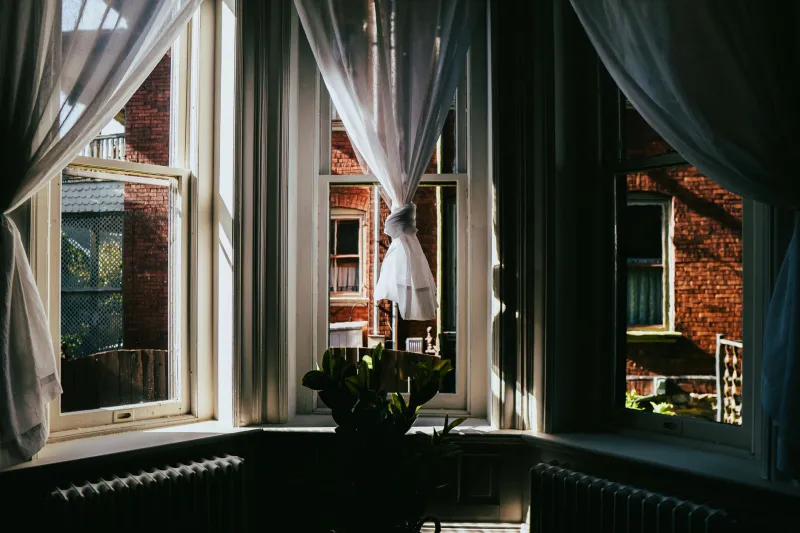
Sash windows are a gift for temperature control and a menace for everything else. The lower sash lifts, the upper sash drops, and if you open both a couple of inches you get a proper through-flow of air without a gale across the bed. Trickle vents — those small slatted panels at the top — are made for the mild version of the same job and are much quieter.
What you shouldn't do is wedge anything open with a chair, and you certainly shouldn't prop open a fire door to get a draught through. Ground-floor rooms and anything opening onto a fire escape or a flat roof should stay shut at night regardless of how warm it gets.
The honest trade-off in a town centre is noise versus air. If the room faces a high street, opening the window at 11pm means hearing the last of the pubs and, in some places, the first of the bin lorries. A fan solves that argument better than a window does.
Too warm: the stuffy-room playbook
Ask reception for a fan. Most hotels have a few, and many have a decent one tucked in a cupboard for exactly this reason. It's one of the easiest yeses in the building.
Beyond that: close the curtains during the day if the sun is on that side, keep the bathroom door shut after a shower so the steam doesn't migrate, and don't drape towels over the radiator — it traps heat in the wrong place and does the room no favours. If the duvet is a heavy 13.5 tog and you're wilting, ask whether there's a lighter one. Plenty of places keep a summer-weight option in the linen store.
Too cold: layers before logistics
Spare blankets are standard and usually in the wardrobe, on top of it, or a phone call away. Hot water bottles are rarer but not unheard of in small independent places. Extra duvets are almost always available if you ask nicely and early.
Portable heaters are where it gets patchy. Some hotels will bring one up without a second thought; others won't, for fire safety and insurance reasons, and that's a fair position rather than an unhelpful one. If the room is genuinely underheated in January, that's a different conversation — that's a fault, not a preference.
What to say at reception, and when
Be specific, be timed, and be brief. "Room 12 is quite warm overnight — is there a fan we could borrow?" lands well at 4pm. "The heating's broken" delivered at half eleven at night lands less well, especially if it isn't broken.
If you know you run hot or cold, mention it at check-in rather than discovering it at 2am. And if the room simply doesn't work — a radiator that won't turn off, a window painted shut, an actual fault — ask about moving. In a half-empty hotel that's a small request; even in a busy one, most teams would rather shuffle things than have you spend the night uncomfortable and say so afterwards.
The goal is a comfortable night, not a project. A quarter-turn of a valve, one window opened two inches, a fan borrowed before dinner. That's usually the whole job — and the rest of the stay can get on with being a break.