The Humble Three-Pin: What UK Hotel Sockets Say About Your Room
There are grander ways to judge a hotel room. The view, the bed, the smell of the corridor. But few details are as quietly revealing as the power points. A socket in the right place says someone thought about how you will use the room. A socket hidden behind a chest of drawers says something else entirely. In the UK, where the three-pin plug is a chunky, reassuring thing, the placement of sockets is a small but useful audit of a room's age, layout and general thoughtfulness.
This is not a technical guide to electrical systems. It is a practical one, written for anyone packing an overnight bag for a British hotel stay in 2026 and hoping to charge a phone without crawling under a desk.
Start with the bed, not the desk
Hotels often advertise a desk, a lamp and a kettle. They are less forthcoming about whether the bedside socket is within arm's reach of the pillow. This matters. A phone charging across the room is a phone you will check less often, which is either a digital detox or an inconvenience, depending on your plans. If you use a phone as an alarm, a sleep tracker or a white-noise machine, a distant socket is a genuine problem.
When you arrive, look at both sides of the bed. A well-planned room usually has at least one accessible point per side, or a lamp with an integrated socket. Older properties sometimes have a single socket behind the headboard, which is technically available but practically a yoga pose. If you are travelling with a partner and both of you charge devices overnight, ask before booking whether there are bedside sockets on both sides. It sounds fussy. It is not.
The USB question
USB ports are now common in UK hotels, but they are not all equal. Some are built into lamps or wall plates and are genuinely handy. Others are slow, loose, or positioned so that the cable dangles awkwardly over a bedside table. A USB-A port is fine for a phone overnight; it is less useful for a tablet or a laptop. USB-C is increasingly common, but not yet universal.
Treat built-in USB ports as a bonus, not a guarantee. If you rely on fast charging, bring your own three-pin plug and cable. The UK three-pin socket remains the most dependable point in the room. It is also worth checking whether the socket is switched on at the wall — a surprising number of hotel sockets have a small switch beside them, and a dead socket is often just a switch in the off position.
Where the desk lets a room down
A desk socket is useful for laptops, camera batteries and anything else that needs a proper charge. The common failure is placement: a socket under the desk at skirting-board level, or behind a fixed drawer unit. If you plan to work, look for a socket at desktop height or just above. If you are only charging a phone, the desk is less important.
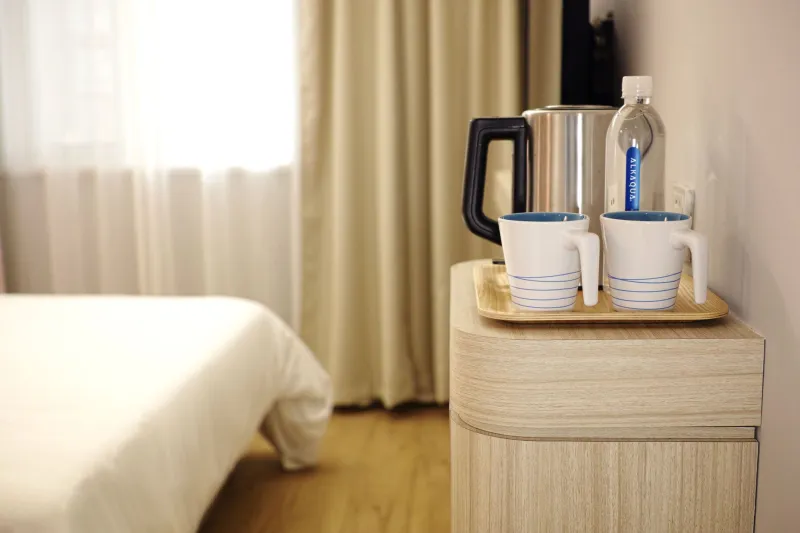
Tea trays are another clue. A kettle needs a socket nearby, but hotels often put the tray on a shelf with no obvious power point. That is usually a sign the room has been refurbished in stages rather than planned as a whole. It is not a dealbreaker, but it tells you to check the room before you settle in.
The short extension lead worth packing
A short extension lead is one of the most useful things you can put in an overnight bag. Not a bulky reel, just a compact four-way strip or a one-metre extension. It turns a badly placed socket into a workable one and lets you charge two things from a single point. For UK stays, choose one with a standard three-pin plug and check that it is rated for the devices you plan to use.
This is especially useful in older hotels, where sockets may be sparse, and in family rooms, where several people are charging several devices. It is also a small kindness to your future self at 11pm when the only free socket is behind the curtains.
Bathrooms, shaver points and accessible rooms
Bathroom sockets in UK hotels are usually shaver points, not general-purpose sockets. Do not expect to charge a phone there. If you use an electric toothbrush or shaver, check whether the point accepts your plug and whether it is switched on.
For accessible rooms, socket placement matters more than many booking pages admit. A socket at skirting level may be unreachable from a wheelchair or a bed with limited clearance. If you need power beside the bed or near a mobility aid, ask the hotel directly and be specific: which side of the bed, what height, and whether there is clear floor space in front of it. A good hotel will check the actual room rather than guess.
Family rooms have a similar issue. Four people, four devices, one socket behind a wardrobe is a recipe for mild chaos. Ask whether there are spare sockets near the bunk beds or sofa bed, and pack a short extension lead as backup.
Two questions worth asking before you book
First: are there bedside sockets on both sides of the bed, and are they reachable without moving furniture? Second: if you need to work or charge several devices, is there a socket at desk height? These are simple questions, and a hotel that answers them clearly is usually a hotel that knows its rooms.
Socket placement will never be the headline reason to choose a stay. But it is part of the quiet contract between a hotel and a guest: you arrive with things that need power, and the room should make that easy. A three-pin socket in the right place is a small piece of hospitality. A socket in the wrong place is a small chore. Pack the extension lead, ask the question, and let the room get on with being comfortable.