Measure Twice, Book Once: A UK Hotel Access Check for the Whole Route
At PJ Hotel, we think a comfortable stay begins before you click book. Accessibility is one of those areas where the brochure can be technically right and practically useless. A room may be labelled accessible, a entrance may be step-free, and a bathroom may have a grab rail — but the trip can still fall apart at the last metre. The useful question is not whether a hotel says it is accessible, but whether the route you will actually take works for you.
Start with the journey, not the room
Most listings begin with the bed. Begin instead with the arrival. If you are driving, where can you stop to unload, and how far is that from reception? If you use a Blue Badge, is there a bay near the entrance, and is it on level ground? If you are coming by train, what happens between the taxi drop-off and the front door? A dropped kerb, a gravel path, a steep ramp or a single lip at the entrance can matter more than the room itself.
Step-free is a phrase worth testing. It should describe a continuous route, not just the front step. Ask whether the path from the car park or pavement is level, firm and lit. Ask whether the entrance doors are automatic or manually opened, and whether there is space to pause inside without blocking other guests. A hotel can be genuinely step-free and still be tiring if the lift is at the far end of the building or the accessible room is a long corridor away from everything.
The bathroom is where the details go quiet
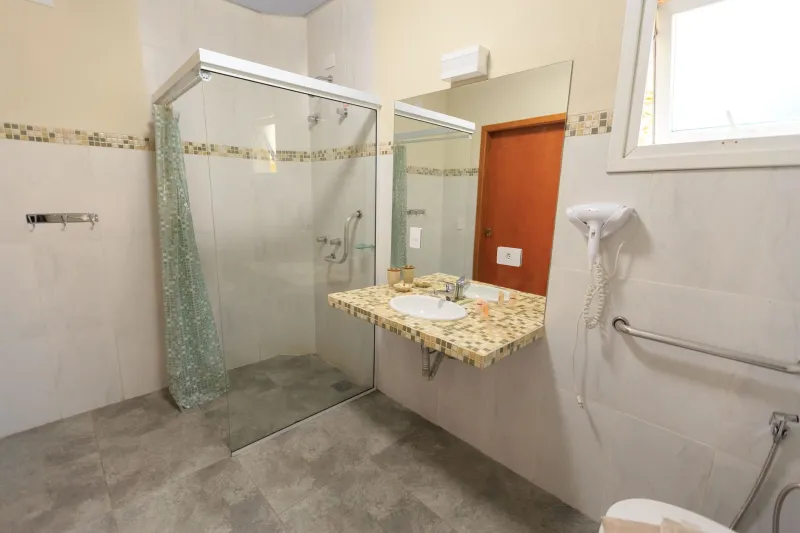
Bathrooms are often the place where accessibility information becomes shy. A listing may mention a walk-in shower but not the threshold. It may show a grab rail but not where it sits. It may say accessible bathroom without explaining whether the door opens inwards or outwards, how wide the clear opening is, or whether there is space to turn beside the loo.
Ask for measurements rather than adjectives. What is the clear opening width of the bathroom door? How high is the shower tray or threshold? Is the shower a wet room, and if so, does the floor slope in a way that feels secure? Is there a shower seat, and is it fixed or movable? Are the grab rails beside the loo, in the shower, or both? If you need a hoist, ask directly whether one is available, whether it is ceiling-track or portable, and whether staff are trained to set it up.
Photos help, but only if they are recent and honest. A wide-angle shot can make a small bathroom look generous. Ask for a picture that includes a doorway, a tape measure or a person for scale. If the hotel cannot provide one, that is not automatically a red flag, but it does mean you need more detail in writing.
Lifts, corridors and the bits between
A lift that fits a wheelchair is not necessarily a lift that fits a wheelchair, a companion and a suitcase. Ask for the internal dimensions and the door width. Ask whether the lift serves the floor where the accessible room is located, and whether there are any steps between the lift and the room. Corridors matter too: tight corners, heavy fire doors, housekeeping trolleys and narrow turns can turn a short walk into a obstacle course.
Floor plans are useful, but read them with a little suspicion. They can be schematic rather than measured, and they rarely show door swings, thresholds or clutter. If a plan shows the accessible room near the lift, check that it is the room you are actually booking. Some hotels have one adapted room and several rooms that are merely larger than average. Ask which specific room category is accessible, and whether you can reserve that exact room rather than a general room type.
Ask questions a tick box cannot answer
A yes or no form is a poor substitute for a conversation. Instead of asking whether the hotel is accessible, ask what happens at each stage. What is the distance from the nearest parking bay to the room? How wide are the bedroom and bathroom doors? What is the bed height? Is there turning space on both sides of the bed? Are there any steps inside the room, including to a balcony or bathroom? Can the hotel send photos of the route from entrance to room?
Put the questions in an email so the answers are in writing. If you speak on the phone, ask for a short summary by email. A good hotel will not mind. A great one will answer precisely and tell you what it cannot promise. That is more useful than a glossy page with a wheelchair symbol and no measurements.
The evacuation question
It is not the most relaxing topic, but it belongs in the pre-booking check. Ask whether the hotel has a personal emergency evacuation plan, what the fire alarm sounds and looks like, and whether staff are on site overnight. If you cannot use stairs, ask how assistance would work and whether there is a refuge area. You do not need to make the question dramatic. A simple line works: I use a wheelchair and cannot use stairs — what is your procedure? The way a hotel answers tells you a lot about how it thinks.
The last-metre checklist
Before you book, run through the whole route in your head:
- The path from car, taxi or station to reception
- The entrance doors and any thresholds
- The lift size, door width and location
- The corridor turns and fire doors
- The bedroom door and bathroom door clear widths
- The bathroom layout, shower threshold and grab rails
- The bed height and turning space
- The parking-to-room distance
- The evacuation procedure and overnight staffing
- A named contact who can confirm the details
If the answers are vague, that is information too. It may simply mean nobody has asked before, but on a short break you do not want to be the first test case. Ask for one named person to confirm the route in writing. If the details still will not come, consider whether another hotel will give you a calmer, clearer answer. At PJ Hotel, we would rather help you ask the awkward question now than have you discover the hardest metre after you arrive.